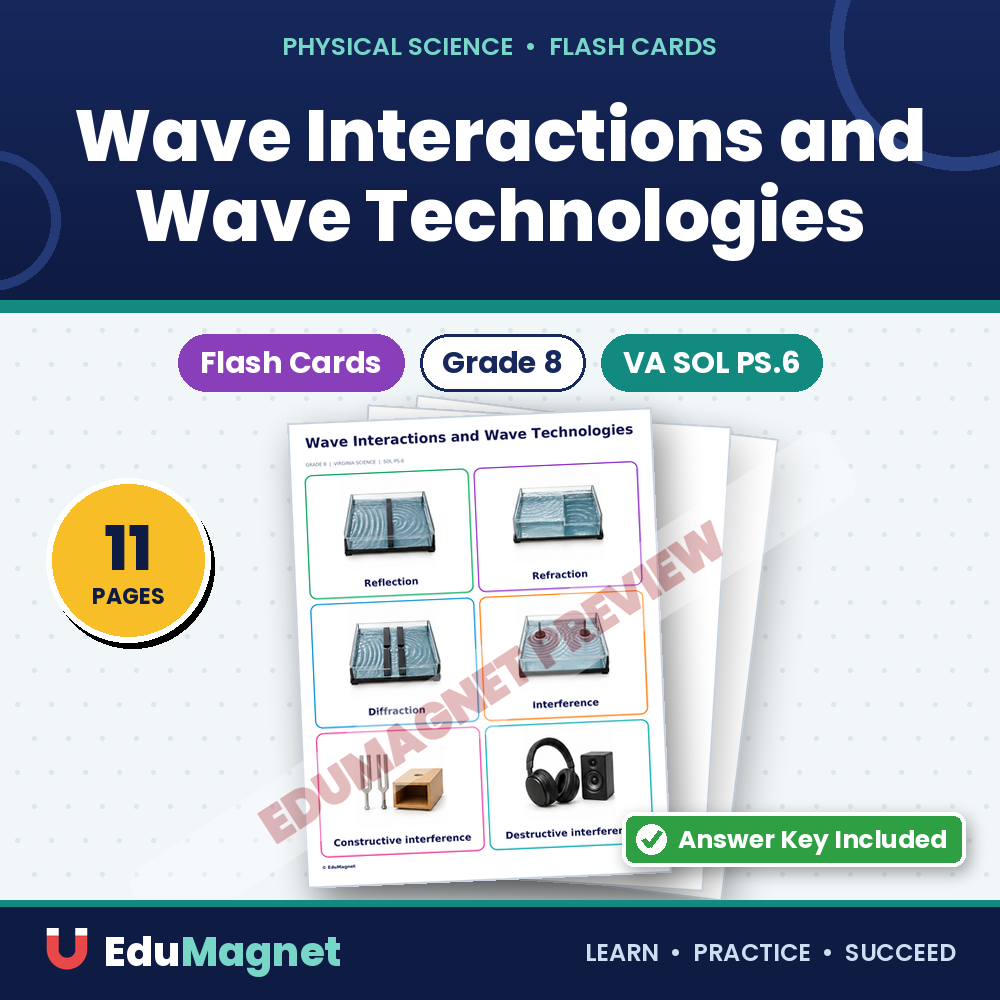
Build the key vocabulary of Wave Interactions and Wave Technologies with this printable picture flash card set for Grade 8 physical science, aligned to Virginia SOL PS.6. It covers 12 essential terms, from Reflection and Refraction to Wave power. Each term comes as a picture-and-word card and as a picture card with a clear, full-sentence definition, and two labeling worksheets let students show what they know.
Learning goal: Wave behavior, resonance, and technologies using sound or water-wave energy.
What students practice
- Reflection: Reflection occurs when a wave reaches a boundary and returns into its original medium, allowing effects such as echoes and reflected water waves.
- Refraction: Refraction occurs when a wave’s speed changes as it enters different conditions, often changing its direction when it crosses the boundary at an angle.
- Diffraction: Diffraction is the spreading of waves beyond an opening or around an obstacle, with the resulting pattern depending on wavelength and obstacle or opening size.
- Interference: Interference occurs when waves overlap, producing a combined disturbance determined by their displacements while the original waves can continue beyond one another.
- Constructive interference: Constructive interference occurs when overlapping wave displacements reinforce one another, temporarily producing a larger combined displacement than either wave would produce alone.
- Destructive interference: Destructive interference occurs when overlapping wave displacements oppose one another, temporarily reducing the combined disturbance and sometimes canceling it at a particular location.
- Resonance: Resonance occurs when a repeated driving disturbance matches a system’s natural response frequency, allowing energy transfer that can produce a large vibration amplitude.
- Sonar: Sonar uses sound and returning echoes to locate objects or estimate distances underwater, with travel time interpreted using the sound speed in water.
- Ultrasound imaging: Ultrasound imaging uses high-frequency sound and returning echoes to build representations of internal structures, without relying on ionizing electromagnetic radiation to form the image.
- Parking sensor: Some parking sensors emit ultrasonic sound and measure returning echoes to estimate obstacle distance, helping a vehicle detect nearby objects without direct contact.
- Noise cancellation: Active noise cancellation produces controlled sound designed to reduce some unwanted sound through destructive interference, with effectiveness depending on conditions and frequency.
- Wave power: Wave-power technology captures some energy from moving ocean waves and transfers it through mechanical systems to generators that produce electrical energy.
Teaching notes from the key: Wave interactions depend on geometry, medium, wavelength, and timing; use accurate native diagrams when precise relationships are illustrated. Distinguish ultrasound, which is mechanical sound, from electromagnetic radiation such as X-rays.
What’s included (11 pages)
- 12 color picture-and-word cards
- 12 picture–term–definition cards (4 pages)
- 12 black-and-white picture-and-word cards for low-ink printing or coloring
- 2 picture-labeling worksheets: students write the matching term for each picture (with Name and Class lines)
- Answer key (1 page) for the labeling worksheets
How to use it in class
- Print the color cards (or the black-and-white set to save ink), cut them apart and laminate them to reuse.
- Introduce the words with the picture-and-word cards, then use the definition cards to talk about what each term means.
- Play quick games: show a picture and ask for the term, read a definition and ask which card it matches, or sort the cards into groups.
- Use the labeling worksheets as an exit ticket, homework or review, and check them with the answer key.
- Put the cards in a word wall or science center for independent practice.
At a glance
- Grade: 8
- Subject: Physical Science (Wave Interactions and Wave Technologies)
- Standard: Virginia SOL PS.6
- Pages: 11
- Format: Printable PDF; instant digital download after purchase

 EduMagnet