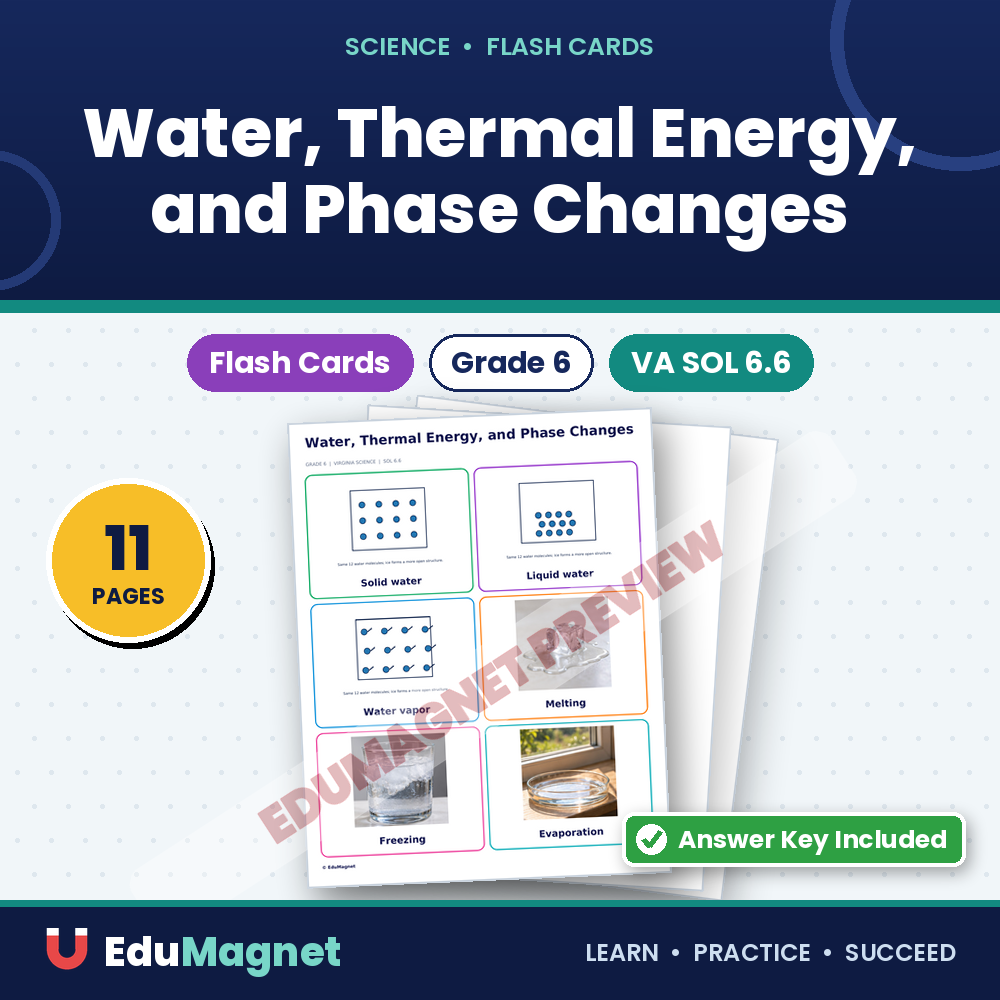
Build the key vocabulary of Water, Thermal Energy, and Phase Changes with this printable picture flash card set for Grade 6 science, aligned to Virginia SOL 6.6. It covers 12 essential terms, from Solid water and Liquid water to Moderating climate. Each term comes as a picture-and-word card and as a picture card with a clear, full-sentence definition, and two labeling worksheets let students show what they know.
What students practice
- Solid water
- Liquid water
- Water vapor
- Melting: Melting changes solid water into liquid as energy is added. During melting at constant pressure, temperature can remain steady while the phase changes.
- Freezing: Freezing changes liquid water into solid as energy is removed. The particles form an organized arrangement, but they continue vibrating.
- Evaporation: Evaporation changes liquid water into vapor from its surface. It can occur below the boiling temperature and removes energy from the remaining liquid.
- Boiling: Boiling changes liquid water into gas throughout the liquid when vapor bubbles can form. The boiling temperature depends on the surrounding pressure.
- Condensation: Condensation changes water vapor into liquid when conditions allow molecules to collect. Tiny liquid droplets form clouds and appear on cold surfaces.
- Sublimation: Sublimation changes solid water directly into water vapor without an intermediate liquid phase. Ice and snow can slowly disappear under suitable conditions.
- Deposition: Deposition changes water vapor directly into solid ice. Frost can form on sufficiently cold surfaces when suitable atmospheric conditions are present.
- Thermal storage: Water can absorb or release substantial energy with relatively modest temperature changes. Large water bodies therefore store and redistribute thermal energy effectively.
- Moderating climate: Large bodies of water warm and cool more slowly than nearby land. They can reduce seasonal temperature extremes in surrounding coastal areas.
Teaching notes from the key: Cloud droplets and the visible white plume above hot water are not invisible gaseous water vapor. Water-cycle changes transfer matter, while thermal energy drives evaporation and is transferred during phase changes.
What’s included (11 pages)
- 12 color picture-and-word cards
- 12 picture–term–definition cards (3 pages)
- 12 black-and-white picture-and-word cards for low-ink printing or coloring
- 2 picture-labeling worksheets: students write the matching term for each picture (with Name and Class lines)
- Answer key (1 page) for the labeling worksheets
How to use it in class
- Print the color cards (or the black-and-white set to save ink), cut them apart and laminate them to reuse.
- Introduce the words with the picture-and-word cards, then use the definition cards to talk about what each term means.
- Play quick games: show a picture and ask for the term, read a definition and ask which card it matches, or sort the cards into groups.
- Use the labeling worksheets as an exit ticket, homework or review, and check them with the answer key.
- Put the cards in a word wall or science center for independent practice.
At a glance
- Grade: 6
- Subject: Science (Water, Thermal Energy, and Phase Changes)
- Standard: Virginia SOL 6.6
- Pages: 11
- Format: Printable PDF; instant digital download after purchase

 EduMagnet