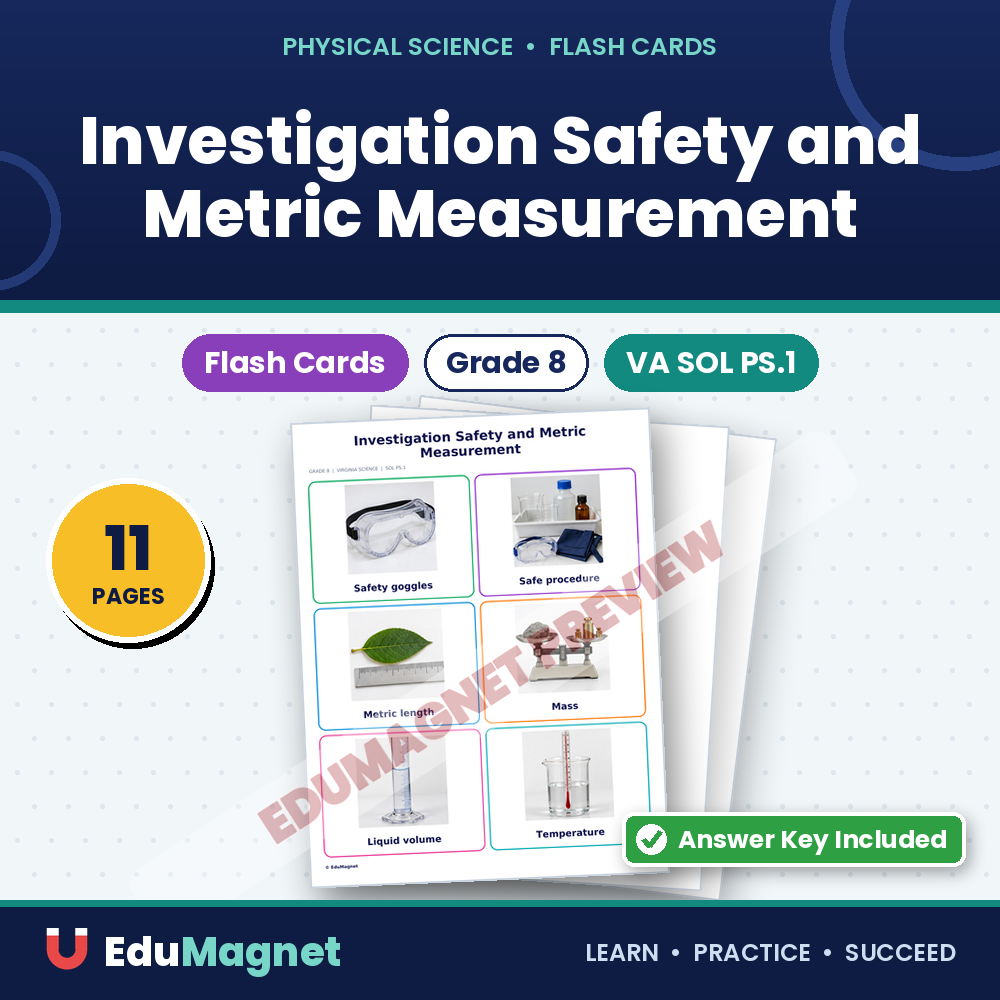
Build the key vocabulary of Investigation Safety and Metric Measurement with this printable picture flash card set for Grade 8 physical science, aligned to Virginia SOL PS.1. It covers 12 essential terms, from Safety goggles and Safe procedure to Instrument range. Each term comes as a picture-and-word card and as a picture card with a clear, full-sentence definition, and two labeling worksheets let students show what they know.
Learning goal: Safe investigations, metric measurements, tool choice, accuracy, and precision.
What students practice
- Safety goggles: Safety goggles protect the eyes from specified classroom hazards and must be used with other procedures appropriate to the investigation’s materials and equipment.
- Safe procedure: A safe procedure anticipates hazards, follows instructions, handles equipment appropriately, and includes suitable cleanup and disposal before an investigation begins.
- Metric length: Metric length describes distance using units such as meters, centimeters, and millimeters, measured with an appropriately sized ruler or measuring tape.
- Mass: Mass measures an object’s inertia and amount of matter; a laboratory balance commonly reports measurements in grams or kilograms for scientific comparisons.
- Liquid volume: Liquid volume describes the space occupied by a liquid, commonly measured in milliliters or liters using suitable graduated equipment at eye level.
- Temperature: Temperature indicates the average kinetic energy associated with particle motion; a thermometer measures it using a specified scale such as degrees Celsius.
- Elapsed time: Elapsed time is the interval between a chosen starting event and ending event, measured consistently using a stopwatch or another suitable timer.
- Accuracy: Accuracy describes how closely a measurement agrees with an accepted reference value; a consistently incorrect instrument can produce measurements with low accuracy.
- Precision: Precision describes how closely repeated measurements agree with one another, even when those measurements do not agree with an accepted reference value.
- Meniscus: A meniscus is the curved surface of a liquid in a container; water volume is usually read at its lowest point at eye level.
- Measurement unit: A measurement unit gives meaning to a numerical value, allowing results to be interpreted and compared when the same quantity is measured.
- Instrument range: An instrument’s range is the interval it can measure; selecting suitable range and divisions helps obtain useful measurements without exceeding the instrument’s limits.
Teaching notes from the key: Read graduations at eye level and record a unit with every measurement. Use low voltage electrical sources, appropriate protective equipment, and teacher approved materials; never use mains electricity in student circuits.
What’s included (11 pages)
- 12 color picture-and-word cards
- 12 picture–term–definition cards (4 pages)
- 12 black-and-white picture-and-word cards for low-ink printing or coloring
- 2 picture-labeling worksheets: students write the matching term for each picture (with Name and Class lines)
- Answer key (1 page) for the labeling worksheets
How to use it in class
- Print the color cards (or the black-and-white set to save ink), cut them apart and laminate them to reuse.
- Introduce the words with the picture-and-word cards, then use the definition cards to talk about what each term means.
- Play quick games: show a picture and ask for the term, read a definition and ask which card it matches, or sort the cards into groups.
- Use the labeling worksheets as an exit ticket, homework or review, and check them with the answer key.
- Put the cards in a word wall or science center for independent practice.
At a glance
- Grade: 8
- Subject: Physical Science (Investigation Safety and Metric Measurement)
- Standard: Virginia SOL PS.1
- Pages: 11
- Format: Printable PDF; instant digital download after purchase

 EduMagnet