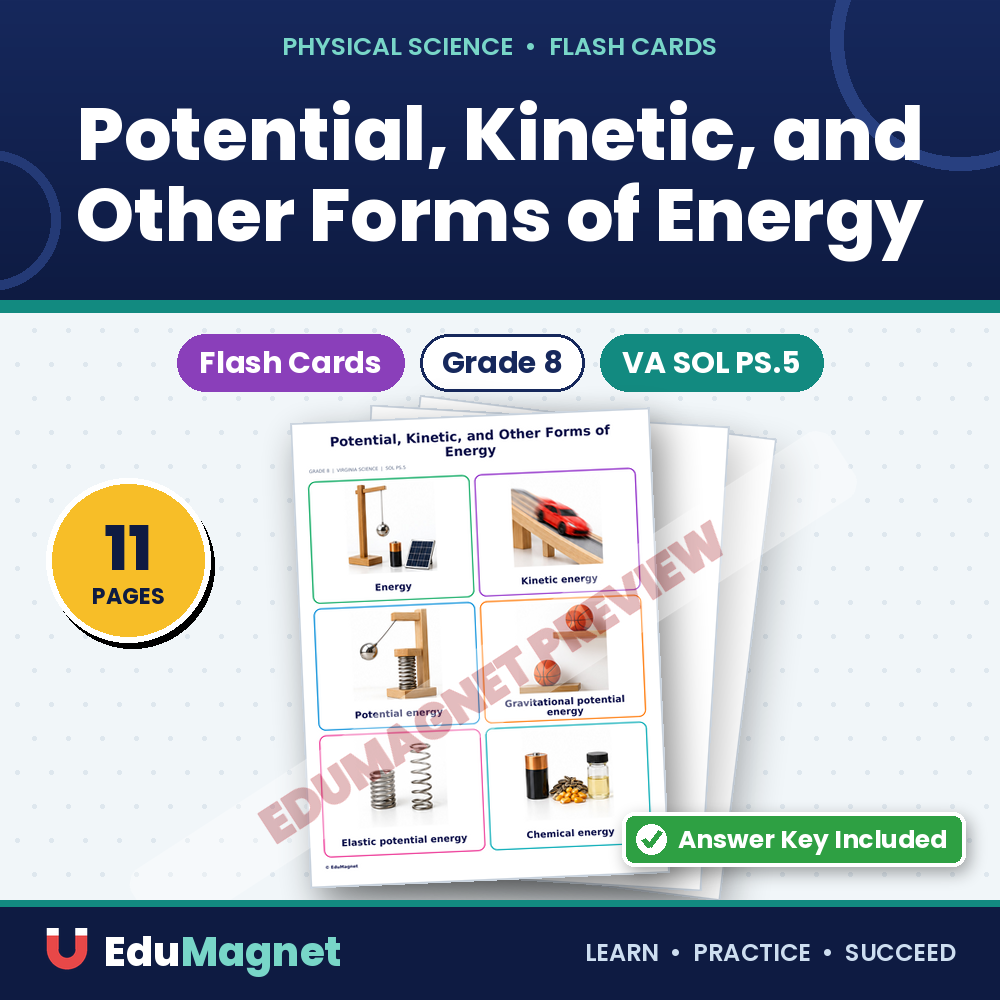
Build the key vocabulary of Potential, Kinetic, and Other Forms of Energy with this printable picture flash card set for Grade 8 physical science, aligned to Virginia SOL PS.5. It covers 12 essential terms, from Energy and Kinetic energy to Mechanical energy. Each term comes as a picture-and-word card and as a picture card with a clear, full-sentence definition, and two labeling worksheets let students show what they know.
Learning goal: Motion, stored energy, and major energy categories in physical systems.
What students practice
- Energy: Energy is a quantity associated with a system’s ability to cause change, transferred among objects or transformed while the total amount is conserved.
- Kinetic energy: Kinetic energy is associated with motion; for an object, it depends on both mass and speed, increasing strongly as speed increases.
- Potential energy: Potential energy is associated with a system’s position, arrangement, or composition, allowing changes in configuration to transfer energy or produce motion.
- Gravitational potential energy
- Elastic potential energy: Elastic potential energy is stored when an elastic object is stretched or compressed, allowing it to transfer energy as it returns toward its original shape.
- Chemical energy: Chemical energy is associated with the arrangement and interactions of atoms; reactions change that arrangement and can transfer net energy to or from surroundings.
- Thermal energy: Thermal energy is associated with microscopic particle motion and interactions in matter, depending on factors including temperature, sample amount, material, and state.
- Electrical energy: Electrical energy is associated with electric charges and their interactions, transferred in circuits to devices that produce light, heating, motion, or other changes.
- Radiant energy: Radiant energy is carried by electromagnetic radiation, including visible light, and can travel through empty space before interacting with matter.
- Sound energy: Sound energy is transferred by mechanical vibrations through a medium, with particles oscillating rather than traveling permanently from the source to the listener.
- Nuclear energy: Nuclear energy is associated with atomic nuclei and can be transferred when nuclear structures change, as in fission, fusion, or radioactive processes.
- Mechanical energy: Mechanical energy is the combined energy associated with an object’s or system’s motion and position, commonly considered as kinetic plus potential energy.
Teaching notes from the key: Energy categories describe useful aspects of systems; track where energy goes instead of saying it disappears. Chemical reactions release net energy only when the overall rearrangement transfers energy outward, not simply because bonds are broken.
What’s included (11 pages)
- 12 color picture-and-word cards
- 12 picture–term–definition cards (4 pages)
- 12 black-and-white picture-and-word cards for low-ink printing or coloring
- 2 picture-labeling worksheets: students write the matching term for each picture (with Name and Class lines)
- Answer key (1 page) for the labeling worksheets
How to use it in class
- Print the color cards (or the black-and-white set to save ink), cut them apart and laminate them to reuse.
- Introduce the words with the picture-and-word cards, then use the definition cards to talk about what each term means.
- Play quick games: show a picture and ask for the term, read a definition and ask which card it matches, or sort the cards into groups.
- Use the labeling worksheets as an exit ticket, homework or review, and check them with the answer key.
- Put the cards in a word wall or science center for independent practice.
At a glance
- Grade: 8
- Subject: Physical Science (Potential, Kinetic, and Other Forms of Energy)
- Standard: Virginia SOL PS.5
- Pages: 11
- Format: Printable PDF; instant digital download after purchase

 EduMagnet