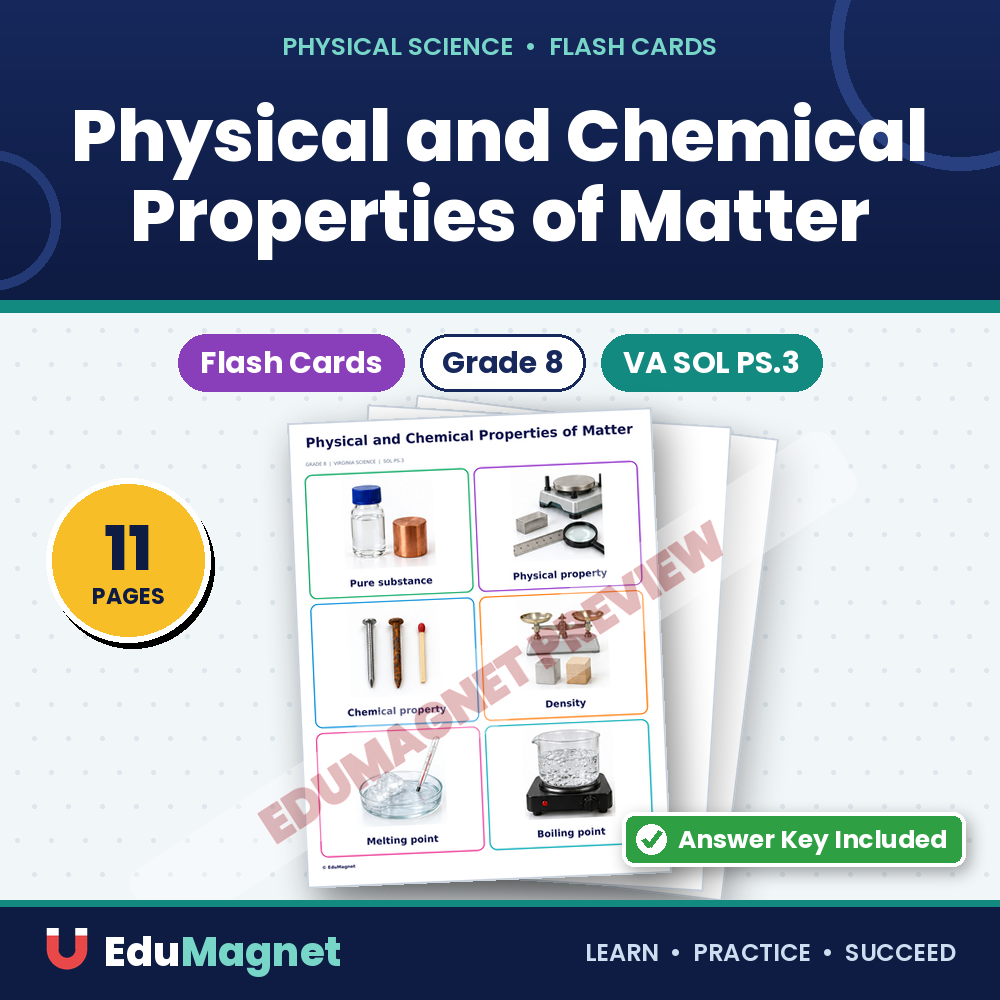
Build the key vocabulary of Physical and Chemical Properties of Matter with this printable picture flash card set for Grade 8 physical science, aligned to Virginia SOL PS.3. It covers 12 essential terms, from Pure substance and Physical property to Acidity and basicity. Each term comes as a picture-and-word card and as a picture card with a clear, full-sentence definition, and two labeling worksheets let students show what they know.
Learning goal: Properties used to identify pure substances and choose useful materials.
What students practice
- Pure substance: A pure substance has a fixed chemical composition and characteristic properties, consisting of one element or compound rather than a variable mixture.
- Physical property: A physical property can be observed or measured without changing a substance’s chemical identity, including density, conductivity, melting point, and solubility.
- Chemical property: A chemical property describes a substance’s ability to undergo a chemical change, such as reacting with another material or burning under suitable conditions.
- Density: Density compares a sample’s mass with its volume; for a pure substance under specified conditions, it can help identify the material.
- Melting point: The melting point is the temperature at which a pure substance changes between solid and liquid at a specified pressure.
- Boiling point: The boiling point is the temperature at which a liquid’s vapor pressure equals external pressure, allowing vapor bubbles to form throughout the liquid.
- Solubility: Solubility describes how much of a substance can dissolve in a given solvent under specified conditions, such as temperature and solvent amount.
- Conductivity: Conductivity describes how readily a material transfers electrical charge or thermal energy, with the type of conductivity identified for a useful comparison.
- Luster: Luster describes how a material’s surface reflects light, such as the shiny appearance of polished metals compared with a dull surface.
- Malleability: Malleability is a material’s ability to be shaped by compression without breaking, explaining why many metals can be hammered into thin sheets.
- Reactivity: Reactivity describes a substance’s tendency to participate in chemical changes, and its observed behavior depends on the other substances and environmental conditions.
- Acidity and basicity: Acidity and basicity describe chemical behavior of aqueous solutions; indicators or pH measurements help compare them using appropriate safe laboratory procedures.
Teaching notes from the key: Density, melting point, and boiling point are useful identifying properties when conditions are specified. Do not identify an unknown chemical by tasting or directly smelling it; use approved measurements and safe materials.
What’s included (11 pages)
- 12 color picture-and-word cards
- 12 picture–term–definition cards (4 pages)
- 12 black-and-white picture-and-word cards for low-ink printing or coloring
- 2 picture-labeling worksheets: students write the matching term for each picture (with Name and Class lines)
- Answer key (1 page) for the labeling worksheets
How to use it in class
- Print the color cards (or the black-and-white set to save ink), cut them apart and laminate them to reuse.
- Introduce the words with the picture-and-word cards, then use the definition cards to talk about what each term means.
- Play quick games: show a picture and ask for the term, read a definition and ask which card it matches, or sort the cards into groups.
- Use the labeling worksheets as an exit ticket, homework or review, and check them with the answer key.
- Put the cards in a word wall or science center for independent practice.
At a glance
- Grade: 8
- Subject: Physical Science (Physical and Chemical Properties of Matter)
- Standard: Virginia SOL PS.3
- Pages: 11
- Format: Printable PDF; instant digital download after purchase

 EduMagnet