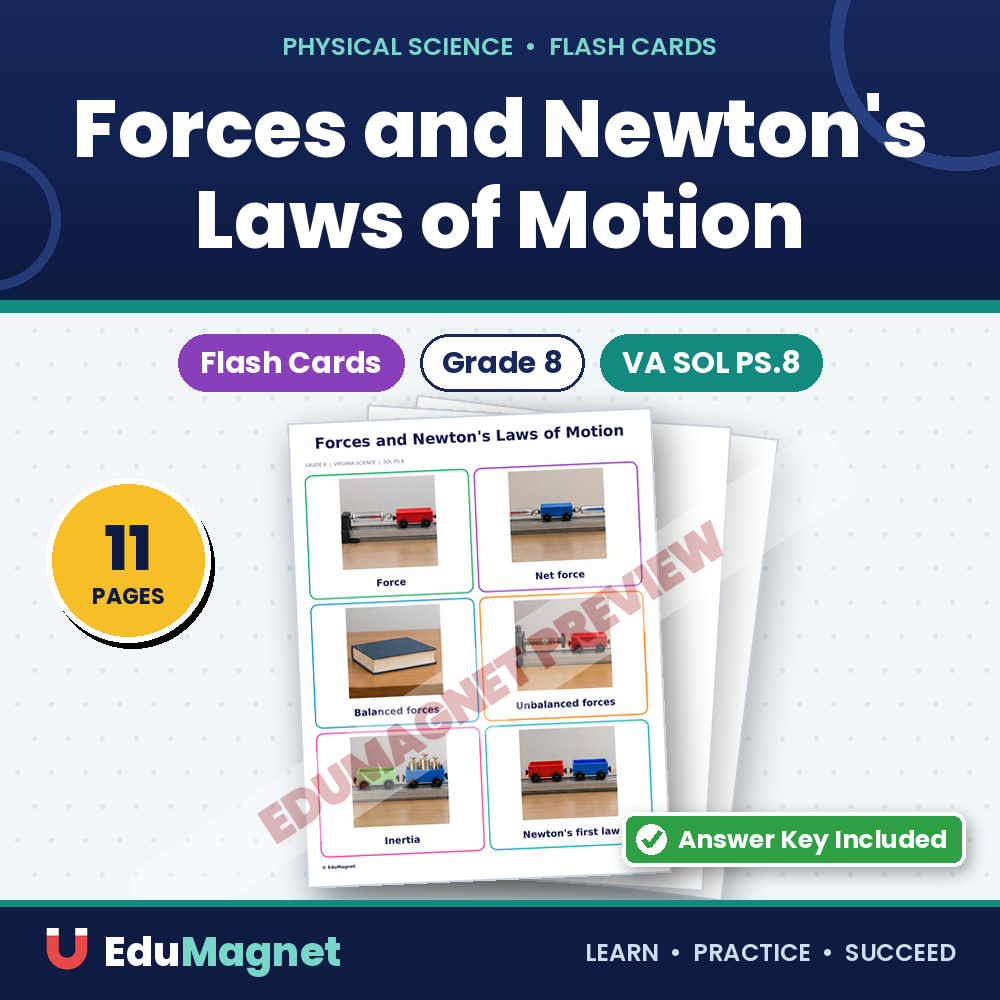
Build the key vocabulary of Forces and Newton’s Laws of Motion with this printable picture flash card set for Grade 8 physical science, aligned to Virginia SOL PS.8. It covers 12 essential terms, from Force and Net force to Weight. Each term comes as a picture-and-word card and as a picture card with a clear, full-sentence definition, and two labeling worksheets let students show what they know.
Learning goal: Net force, inertia, motion changes, friction, gravity, and mass versus weight.
What students practice
- Force: A force is an interaction that can change an object’s motion or shape, described by both magnitude and direction and measured in newtons.
- Net force: Net force is the vector sum of all forces acting on one object; a nonzero net force changes the object’s velocity.
- Balanced forces: Balanced forces have a zero net force on an object, so they do not cause acceleration even when the object is already moving.
- Unbalanced forces: Unbalanced forces produce a nonzero net force on an object, causing acceleration that may change its speed, its direction, or both.
- Inertia: Inertia is an object’s resistance to a change in velocity, with greater mass corresponding to greater inertia under comparable conditions.
- Newton’s first law: Newton’s first law states that an object’s velocity remains unchanged unless a nonzero net external force acts, including remaining at rest when initially motionless.
- Newton’s second law: Newton’s second law relates net force, mass, and acceleration: for constant mass, larger net force produces greater acceleration in the force’s direction.
- Newton’s third law: Newton’s third law states that interacting objects exert equal-magnitude, opposite-direction forces on each other; the paired forces act on different objects.
- Friction: Friction is a force that opposes relative sliding or its tendency between contacting surfaces, transferring mechanical energy into other forms such as thermal energy.
- Gravity: Gravity is an attractive interaction between masses that can act across space, causing effects such as falling objects and orbital motion.
- Mass: Mass measures inertia and the amount of matter in an object, commonly expressed in kilograms, and does not depend on the local gravitational field.
- Weight: Weight is the gravitational force acting on an object, measured in newtons, and changes when the gravitational field changes even if mass remains constant.
Teaching notes from the key: Third-law force partners act on different objects and therefore do not cancel as forces on one object. Distinguish mass from weight, and interpret first-law motion using net external force rather than assuming every individual force is absent.
What’s included (11 pages)
- 12 color picture-and-word cards
- 12 picture–term–definition cards (4 pages)
- 12 black-and-white picture-and-word cards for low-ink printing or coloring
- 2 picture-labeling worksheets: students write the matching term for each picture (with Name and Class lines)
- Answer key (1 page) for the labeling worksheets
How to use it in class
- Print the color cards (or the black-and-white set to save ink), cut them apart and laminate them to reuse.
- Introduce the words with the picture-and-word cards, then use the definition cards to talk about what each term means.
- Play quick games: show a picture and ask for the term, read a definition and ask which card it matches, or sort the cards into groups.
- Use the labeling worksheets as an exit ticket, homework or review, and check them with the answer key.
- Put the cards in a word wall or science center for independent practice.
At a glance
- Grade: 8
- Subject: Physical Science (Forces and Newton’s Laws of Motion)
- Standard: Virginia SOL PS.8
- Pages: 11
- Format: Printable PDF; instant digital download after purchase

 EduMagnet