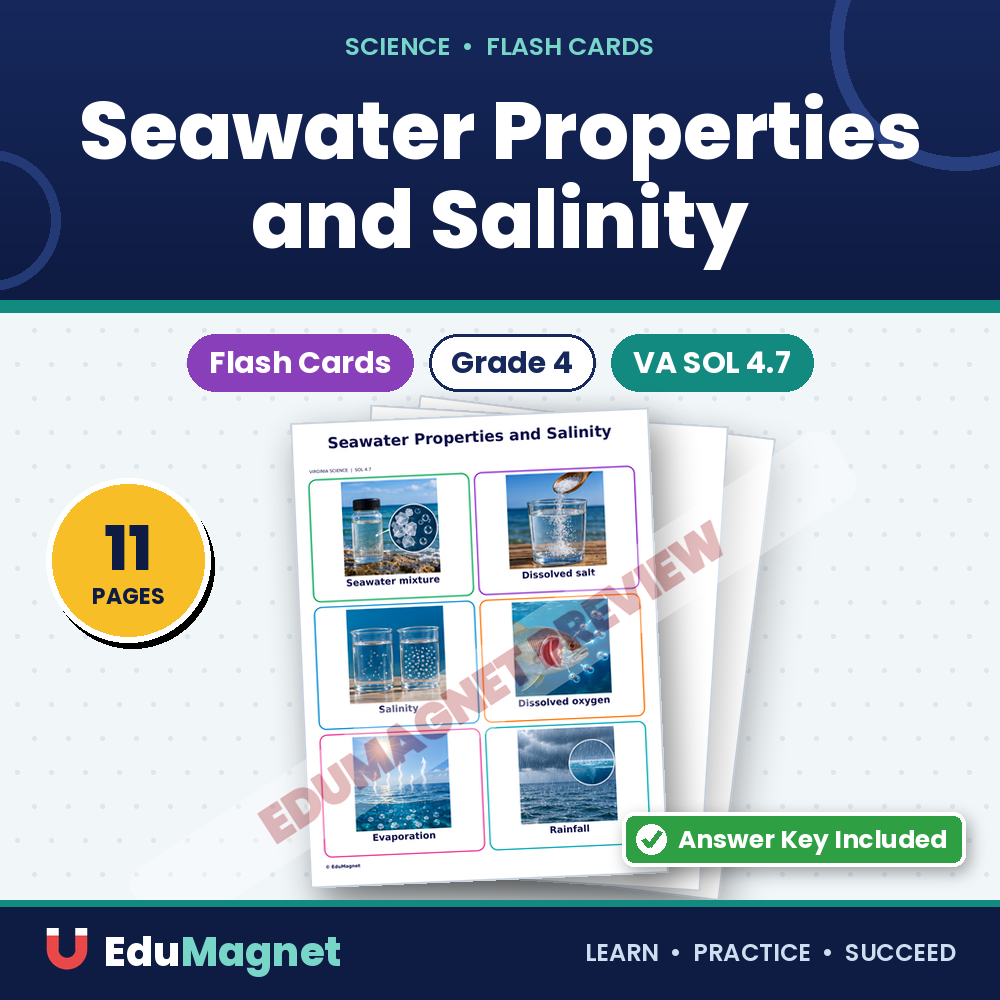
Build the key vocabulary of Seawater Properties and Salinity with this printable picture flash card set for Grade 4 science, aligned to Virginia SOL 4.7. It covers 12 essential terms, from Seawater mixture and Dissolved salt to Salt left behind. Each term comes as a picture-and-word card and as a picture card with a clear, full-sentence definition, and two labeling worksheets let students show what they know.
What students practice
- Seawater mixture: Seawater is a mixture of water, dissolved salts, dissolved gases, and other materials found in the ocean.
- Dissolved salt: When salt dissolves, it spreads through water so its grains can no longer be seen with our eyes.
- Salinity: Salinity describes how much salt is dissolved in water; saltier water has a higher salinity than less salty water.
- Dissolved oxygen: Many marine animals use oxygen dissolved in seawater, taking it into their bodies through structures such as gills.
- Evaporation: When ocean water evaporates, water enters the air while most dissolved salts remain behind in the ocean.
- Rainfall: Rain adds fresh water to the ocean surface and can lower salinity by mixing with the salty water.
- River runoff: Fresh water flowing from rivers into the sea can make nearby coastal water less salty than open ocean water.
- Melting ice: Melting ice adds fresh water to nearby seawater, lowering its salinity by spreading the dissolved salts through a larger amount of water.
- Water temperature: Ocean water temperature varies with location and depth, affecting the conditions experienced by plants and animals living there.
- Fresh water: Fresh water contains much less dissolved salt than seawater and enters oceans through rivers, rainfall, and melting ice.
- Fair comparison: To compare salinity fairly, use equal amounts of water and measure dissolved salt with the same method.
- Salt left behind: Evaporating a small seawater sample can leave salt crystals behind, providing evidence that clear seawater contains dissolved materials.
What’s included (11 pages)
- 12 color picture-and-word cards
- 12 picture–term–definition cards (4 pages)
- 12 black-and-white picture-and-word cards for low-ink printing or coloring
- 2 picture-labeling worksheets: students write the matching term for each picture (with Name and Class lines)
- Answer key (1 page) for the labeling worksheets
How to use it in class
- Print the color cards (or the black-and-white set to save ink), cut them apart and laminate them to reuse.
- Introduce the words with the picture-and-word cards, then use the definition cards to talk about what each term means.
- Play quick games: show a picture and ask for the term, read a definition and ask which card it matches, or sort the cards into groups.
- Use the labeling worksheets as an exit ticket, homework or review, and check them with the answer key.
- Put the cards in a word wall or science center for independent practice.
At a glance
- Grade: 4
- Subject: Science (Seawater Properties and Salinity)
- Standard: Virginia SOL 4.7
- Pages: 11
- Format: Printable PDF; instant digital download after purchase

 EduMagnet